If the motor on your pump or fan is wired straight to the mains, it only knows one speed: full speed. Not "the speed the process needs right now" - full speed, every hour of every shift, whether you need that much flow or not. Somewhere between the motor and the actual demand, that difference has to go somewhere. In most plants, it goes straight into your electricity bill, your maintenance budget, and the lifespan of the equipment.
A variable frequency drive (VFD) is the piece of equipment that closes that gap. It sits between the incoming power and the motor and controls exactly how fast the motor turns - and how gently it gets there. That sounds like a small change. The numbers behind it usually aren't.
A pump running at 80% speed instead of 100% doesn't use 80% of the power. Thanks to the pump affinity laws, it uses roughly half - about 51%.
Direct-on-line start vs. soft start: what actually happens at "Start"
Switch a motor directly onto the mains (a "direct-on-line" or DOL start) and it tries to reach full speed in a fraction of a second. To do that, it draws a surge of current - commonly 5 to 8 times its rated current - for the first moments of the start. That surge doesn't just stress the electrical supply; it slams a mechanical shock through the shaft, the coupling, the belt, and whatever the motor is driving.
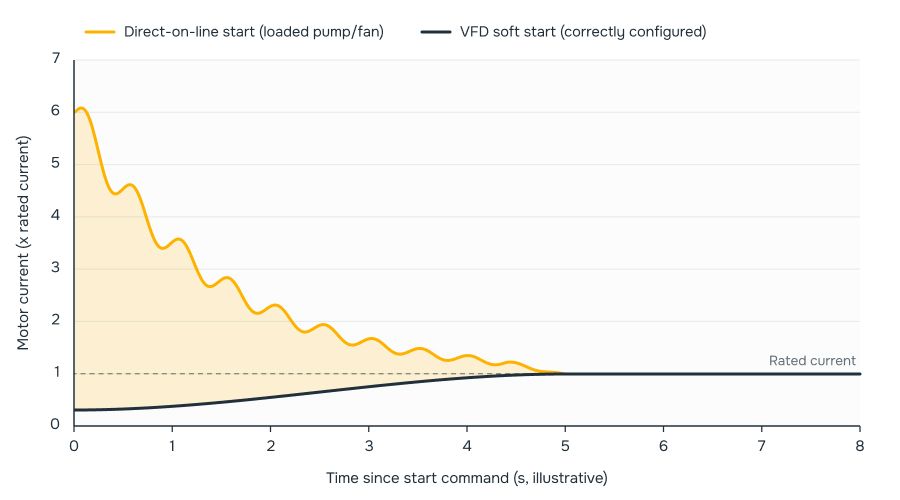
Figure 1. Illustrative starting-current profile for a loaded pump or fan: a direct-on-line start draws several times rated current for the actual acceleration period (often a few seconds, not milliseconds) before settling; a correctly configured VFD soft start stays at or below rated current throughout the ramp.
A VFD replaces that jolt with a controlled ramp. It brings the motor up to speed over a set number of seconds, following a curve you choose. The inrush current drops dramatically, the mechanical shock disappears, and - for pumps in particular - you avoid the pressure spike known as water hammer, which is a common cause of burst pipework and failed seals.
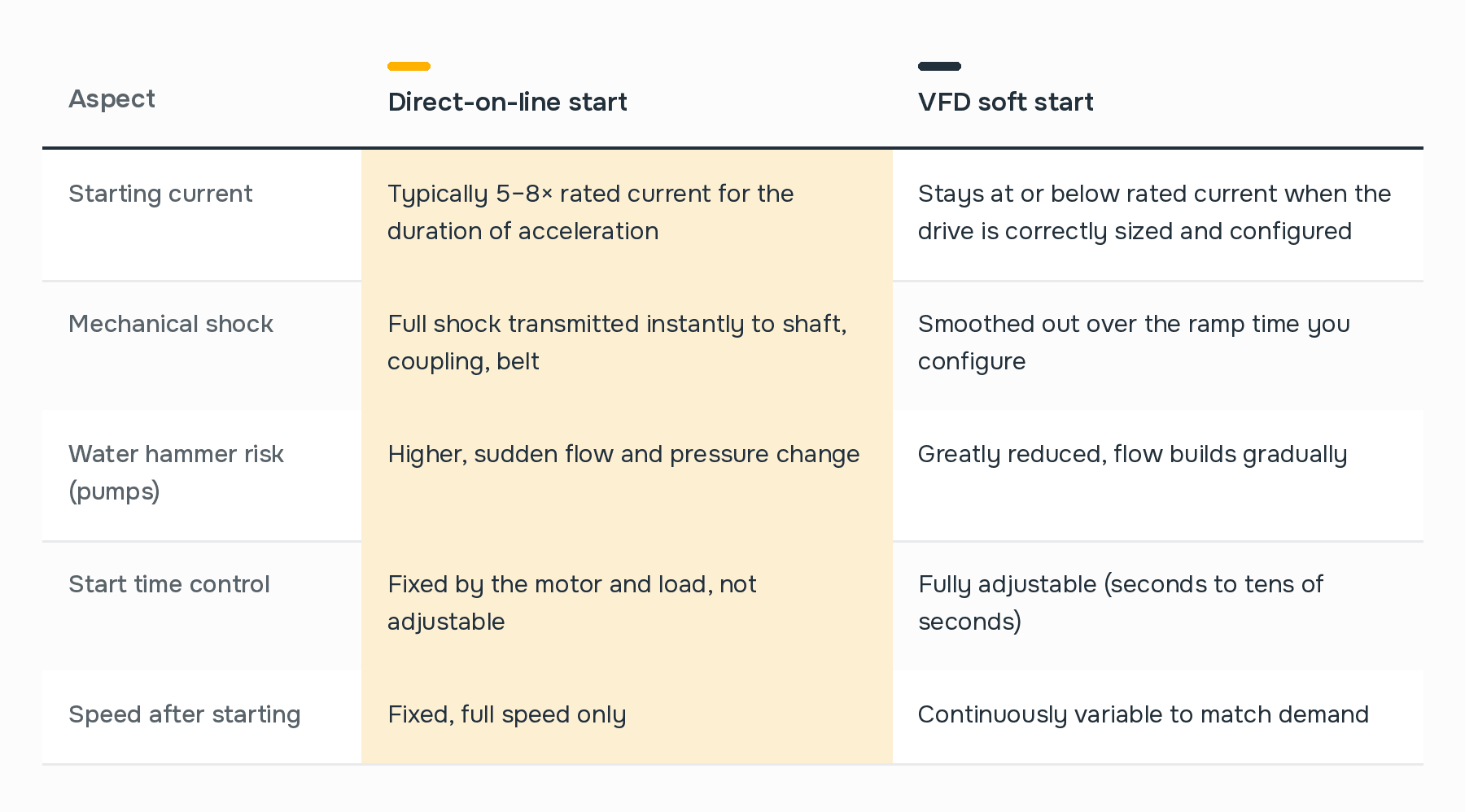
Table 1. Direct-on-line start vs. VFD soft start, side by side.
Mechanical wear you don't see until it's a work order
Every uncontrolled start and stop is a small fatigue event for the mechanical system: bearings absorb a shock load, belts stretch and slip, couplings twist, and shaft seals take a hit of pressure they weren't sized for. None of it shows up on a gauge that day. It shows up eighteen months later as a bearing failure, a snapped belt, or a seal that starts weeping at the worst possible time.
Soft starting through a VFD doesn't just save energy at start-up - it removes the repeated shock loading that quietly shortens the working life of the pump, fan, gearbox, and everything bolted to it. Fewer emergency work orders, more predictable maintenance, less unplanned downtime.
Throttling: the classic way to overpay for flow you don't need
Before VFDs became standard, the usual way to reduce flow was to leave the motor running flat-out and throttle it back with a valve or a damper - closing it partway to fight the pump or fan and force less flow through. It works, but it's the mechanical equivalent of driving with your foot flat on the accelerator and controlling your speed with the brake pedal. The motor still burns full power; the difference is wasted as heat and turbulence at the restriction.
A VFD takes the opposite approach: instead of fighting the pump, it changes how fast the pump turns. And because power follows a cube relationship with speed for this type of load, small reductions in speed produce disproportionately large reductions in power draw.
This cube-law relationship applies specifically to centrifugal pumps and fans operating under variable-torque (quadratic load) duty - the load torque itself falls off with speed. It does not apply to positive-displacement pumps or other constant-torque loads, where cutting speed does not deliver the same power reduction. Confirm the load type before using this relationship to estimate savings.
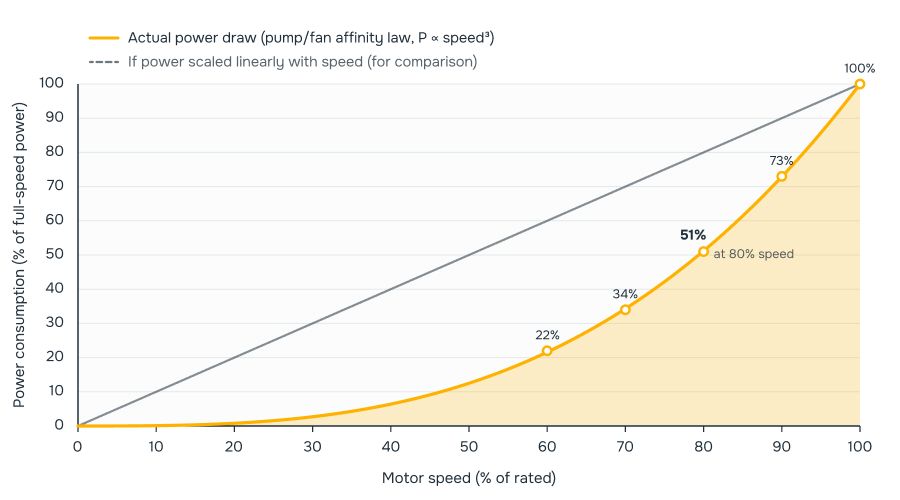
Figure 2. Power consumption falls off much faster than speed—the basis of every VFD energy-savings case for pumps and fans.
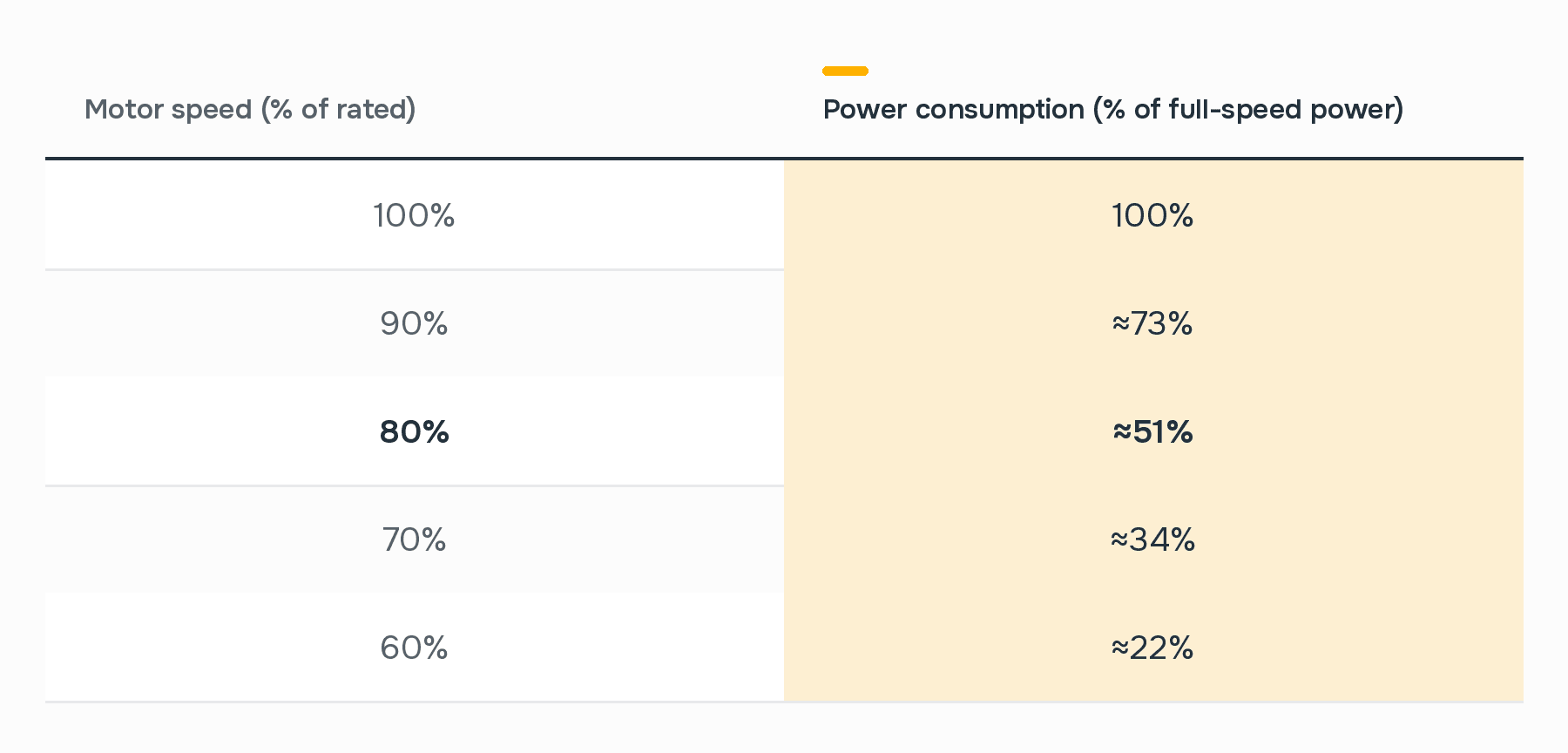
Most real-world systems don't need 100% flow around the clock - demand varies by shift, by season, by process step. Every hour spent at reduced flow with a throttled valve instead of a VFD is an hour of paying full price for a fraction of the output.
Soft start and speed control aren't two separate purchases
It's worth being direct about this, because it's the part people underestimate: a single VFD delivers both of the mechanisms above at the same time. It protects the equipment on every start and stop, and it continuously matches motor speed to actual process demand while running. You're not choosing between "protect the equipment" and "cut the energy bill" - the same device does both, continuously, without operator involvement.
Where the payback actually comes from
When people ask about VFD payback, they usually mean the electricity savings alone - and that's often the biggest line item. But the full picture has three components stacking on top of each other:
Energy: lower average power draw whenever the process doesn't need full flow - frequently the largest and most measurable saving.
Maintenance: fewer bearing, belt, coupling, and seal failures from repeated hard starts and pressure spikes.
Uptime: fewer unplanned stops translate directly into fewer missed production hours or service disruptions.
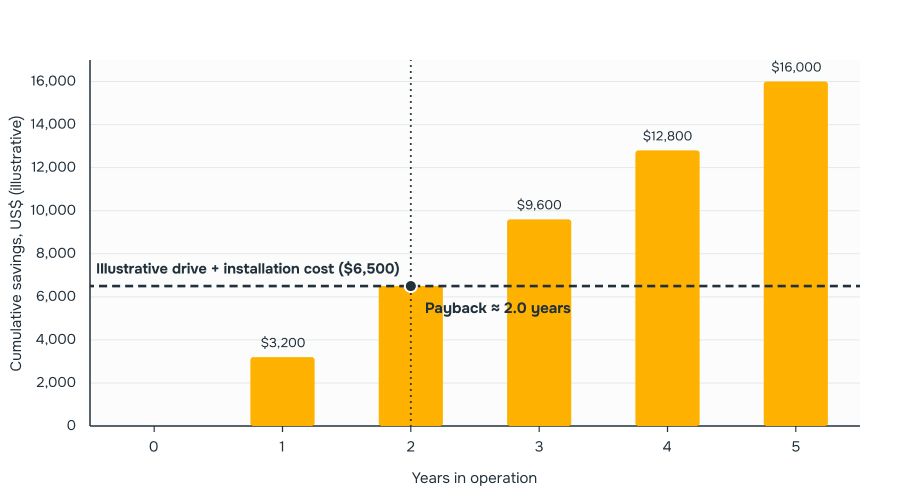
Figure 3. Illustrative example only—a 30 kW pump scenario with assumed energy cost and usage; your actual payback depends on motor size, duty cycle, and local energy price.
A simple illustration: a facility running a 30 kW pump 16 hours a day, with even a modest average speed reduction from better flow matching, can realistically see the drive pay for itself from energy savings alone within one to three years - before the maintenance and uptime benefits are even counted. The exact number depends on your motor size, duty cycle, and local energy cost, which is exactly the kind of back-of-envelope calculation worth doing for your own site before you decide anything.
Where this fits in the AT24 UB family
This is the mechanism, not a product pitch - but it's worth knowing that the same underlying benefit scales from the smallest pump to the heaviest industrial load. Triol's AT24 UB family covers this entire range: from 0.75 kW drives with single-phase supply input (for small pumps and fans, still driving standard three-phase motors - the AT24 UB family does not include single-phase-output drives) up to 900 kW industrial drives, with dedicated versions for outdoor installation, factory-built cabinets, solar-powered pumping, water utilities, and crane applications. Whatever is driving your energy bill and your maintenance log today, there's very likely a model built specifically for it.
Not sure how much a VFD would actually save on your specific pump or fan? Send us the motor size and duty cycle - we'll run the numbers for your site.
Contact Triol team for an energy and payback assessment for your pump, fan, or compressor application.